

TIFF here is not Toronto International Film Festival but Tayur’s Independent Film Festivals experiences!
I came to the US in 1986, to Cornell, for graduate school (Portrait of An Academic Capitalist as a Young Man) and became a fan of independent films.
1986. Blue Velvet. 1987. Raising Arizona. 1988. Cinema Paradiso. 1989. Sex, Lies and Videotape. Do the Right Thing. 1990. Wild at Heart.
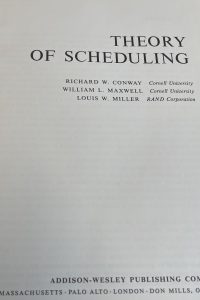
When I joined Cornell ORIE, the Graduate Faculty Representative (GFR) – recall the story of me and Eugene Dynkin from Trillion Dollars of Inventory – who also taught us a course on Scheduling was
William Maxwell, computer simulation pioneer, dies at 91.
RIP Bill. Imagine my pleasant surprise when I received an email that the celebration event of him next month will be held in Rhodes Hall 571, aka Digital Learning Lab, which is a gift from, yes, you guessed it! Life is a Circle?
Back to movies.
Let me jump to 2006 when SmartOps became an Endorsed Business Solution (EBS) of SAP, a pre-cursor to the Sol-Ex agreement in 2009, written about in the Darden Case on SmartOps (that led to the acquisition in 2013). I began sponsoring Silk Screen Film Festival beginning in 2006 through RAGS Foundation, and I met Shonali Bose, Bedabrata Pain and Konkana Sen Sharma (who I had seen in Mr. and Mrs. Iyer a few years earlier) for dinner (and then took them to Mt. Washington and so on to give a night tour of Pittsburgh) because of
Amu is a 2005 Indian English-language drama film directed by Shonali Bose about the 1984 anti-Sikh riots. The film is based on Bose’s own novel by the same name. It stars Konkona Sen Sharma, Brinda Karat, and Ankur Khanna. The film premiered at the Berlin Film Festival and the Toronto International Film Festival in 2005.
The same year, I attended Telluride Film Festival – bumped into Forest Whitaker (The Last King of Scotland) outside a coffee shop, and was thrilled to see Penelope Cruz (wearing a red T-shirt, blue jeans and flats) during a lunch-time celebration honoring her, and was quite gripped during the late night showing of
Babel is a 2006 psychological drama film directed by Alejandro González Iñárritu and written by Guillermo Arriaga. The multi-narrative drama features an ensemble castand portrays interwoven stories taking place in Morocco, Japan, Mexico, and the United States. Babel received positive reviews and was a financial success, grossing $135 million worldwide (on a budget of $25 million). It won the Golden Globe Award for Best Motion Picture – Drama, and received seven Academy Award nominations, including Best Picture, Best Director, and two nominations for Best Supporting Actress (Adriana Barraza and Rinko Kikuchi). It won the award for Best Original Score.
In 2012, I went to Sundance – after giving the Marschak Lecture at UCLA, thanks Art Geoffrion and Chris Tang for inviting me – and to NYIFF to see
Chittagong is a 2012 Indian historical war drama film directed by Bedabrata Pain. It stars Manoj Bajpayee in the lead role and is based upon events of British India’s Chittagong Uprising. This movie won the 60th National Film Awards for the Best Debut Film of a Director.
For those unfamiliar:
Jacob Marschak (22 July 1898 – 27 July 1977) was a Russian and American economist. His doctoral students include Leonid Hurwicz (Nobel 2007), Harry Markowitz (Nobel 1990) and Franco Modigliani (Nobel 1985).
I returned to Sundance in 2013 – gave a talk at the nearby BYU, see A Model for Success, thanks to the invitation from Robin Roundy, my PhD advisor who had since moved there from Cornell – verbally agreeing to the SAP-SmartOps deal at Starbucks, and then going to watch
Inequality for All is a 2013 documentary film directed by Jacob Kornbluth and narrated by American economist, author and professor Robert Reich. Based on Reich’s 2010 book Aftershock: The Next Economy and America’s Future, the film examines widening income inequality in the United States. It won the festival’s U.S. Documentary Special Jury Award for Achievement in Filmmaking.
In 2016, I went to Tribeca Film Festival, while I was on the Board of Overseers at WGBH, and enjoyed watching
Command and Control is a 2016 American documentary film directed by Robert Kenner and based on the 2013 non-fiction book of the same name by Eric Schlosser. It is based on the 1980 Damascus Titan missile explosion in Damascus, Arkansas between September 18–19, 1980.
In 2019, it was a treat to attend IFFBoston to watch (the first documentary where I am an Executive Producer)
WBCN and The American Revolution is a feature-length documentary film that chronicles progressive rock radio station WBCN-FM in Boston, during the years 1968 to 1974, through the original sights, sounds and stories, and examines the station’s role in both covering and promoting the dramatic social, political and cultural changes that took place during that era. The film was produced and directed by Bill Lichtenstein with the Peabody Award-winning Lichtenstein Creative Media. It won Best Documentary at DC Independent Film Festival.
In 2025, I enjoyed Bonjour Switzerland at MSPIFF. Now in 2026, I was thrilled to attend MSPIFF again to watch Knife and The Gas Station Attendant (and sponsor through RAGS Foundation several awards, see Tayur’s Miscellany) and, yes, I am looking forward to NYIFF later this month that includes deja vu, a documentary by, yes, Bedabrata Pain, twenty years after I first met him, as in
Bees Saal Baad (Hindi: बीस साल बाद, transl. Twenty Years Later) is a 1962 Indian Hindi-language psychological thriller film. It was directed by Biren Nag and produced by Hemant Kumar, who also composed the music and sang some of the songs. The film marks the directorial debut of Biren Nag, and stars Biswajeet , Waheeda Rehman, Madan Puri, Sajjan and Asit Sen. The film is a remake of the 1951 Bengali thriller Jighansa, which itself is based on Arthur Conan Doyle‘s The Hound of the Baskervilles as well as loosely based on Hemendra Kumar Roy’s novel Nishithini Bivishika. The film topped the box office chart in 1962, becoming a “super hit.” The film became very popular for the song “Kahin Deep Jale”, sung by Lata Mangeshkar and written by Shakeel Badayuni for which they won Filmfare Award for Best Female Playback Singer and Filmfare Award for Best Lyricist respectively.


I always wanted to see Bill Maxwell again. He closed the party at my house early in the morning after the last day of the 1st ORSA/TIMS Conference on Flexible Manufacturing Systems. Bill was quite funny that night.