

No Country for Old Men is a 2007 American neo-Western crime thriller film written, directed, produced, and edited by Joel and Ethan Coen, based on Cormac McCarthy’s 2005 novel, starring Tommy Lee Jones, Javier Bardem, and Josh Brolin. The film became a commercial success, grossing $171 million worldwide against a budget of $25 million. It was nominated for eight Academy Awards and won four, including Best Picture. Additionally, Javier Bardem won Best Supporting Actor; the Coen brothers won Achievement in Directing (Best Director) and Best Adapted Screenplay.
Exactly one year ago, on May 22, 2025, I received this email (out of the blue?):
Hi Sridhar,
My name is Jay Gambetta and I lead IBM Quantum. I have seen a few of your recent papers and we have been thinking about quantum optimization of late. I was wondering if you would like to take a few minutes to discuss this topic.
Sure, why not? We had a good chat, and now I am part of IBM Quantum Working Group.
Today is May 22, 2026.
The Report of the May 7th NAE Workshop on Quantum Manufacturing (finalized on 5/17) was made public today (PDF):
Quantum Manufacturing: Bridging Research, Infrastructure, and Supply Chains for Scalable Quantum Systems.
And, NYTimes reported yesterday:
U.S. Plans to Invest $2 Billion and Take Stake in Quantum Firms.
Just last week, BillionToOne (NASDAQ: BLLN), which IPO’d in November 2025, came out of lock-up. As an LP in Neotribe Ventures, an early backer, I watched the numbers land: Fund I at 25x gross MOIC, and the Ignite Fund at 10x.
Sweet.
What is relevant here is not the financial result. It is what BillionToOne actually does — liquid biopsy (see my Management Science paper, August 2025), detecting disease from a blood draw rather than invasive tissue sampling. Science that had to work. Manufacturing that had to scale. Regulatory and reimbursement logic that had to hold.
Every deep technology faces this same gauntlet.
The ones that make it through are the ones where someone paid attention to all of it simultaneously, not just the lab results.
That through-line carries into the rest of this post. The past twelve months have been, for me personally, an extraordinary immersion in another technology navigating exactly the same gauntlet — but with greater scientific uncertainty, manufacturing challenges that are orders of magnitude harder, geopolitical stakes that are existential rather than merely competitive, and a potential payoff that dwarfs what any single liquid biopsy company can deliver.
I gave a keynote, a tutorial, and appeared on a panel on quantum at the INFORMS Annual Meeting in Atlanta last October (Atlanta Quantum). The invited companion article is published in the INFORMS Journal of Data Science. Also that month: Atlantic Quantum — another Neotribe investment, a superconducting qubit startup with serious science — was acquired by Google. Worth noting: Google’s quantum technologists who did the due diligence for the acquisition won the 2025 Nobel Prize in Physics just a few days later! The ecosystem is consolidating around players who can manufacture at scale. Neotribe, it turns out, has now backed two of them. Well done Kittu Kolluri (a classmate from IIT-Madras).
On May 7th this year, I delivered one of four keynotes at the National Academy of Engineering’s workshop on Quantum Manufacturing in Washington, D.C. — alongside other keynotes and panelists from IBM, NVIDIA, PsiQuantum, the U.S. Space Force, Sandia, Applied Materials, General Motors, QED-C, and Bluefors.
NAE convened this workshop precisely because some problems are too important for any single sector to solve alone. The NAE’s role is to provide independent engineering judgment to the nation on challenges that sit at the boundary of what is scientifically possible, economically viable, and politically navigable.
Quantum manufacturing is exactly that kind of challenge.
The workshop’s conclusion, stated plainly by co-chairs AJ Malshe (Purdue) and Samuel Graham (Maryland): the science is mature; manufacturing gaps are now the binding constraint. Three structural gaps surfaced in every session without exception: no national quantum manufacturing roadmap, no publicly accessible manufacturing demonstration facility, and cost per qubit running 10–20x too high for commercial viability.
The supply chain picture (slide from my talk below) was the most sobering. Dilution refrigerators: one supplier, Finland. Synthetic diamonds for color-center qubits: one company, UK. Helium-3: globally limited, $3,000–$4,000 per liter, most accessible natural reserves on the moon. Rare earth elements: China supplies 80% of U.S. imports. Control electronics: Taiwan.
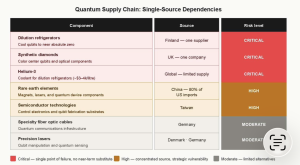
The workshop’s summary was direct: quantum currently has no backup plan for any of these dependencies.
The workforce gap is structural, not just numerical. QED-C data shows PhD-level staff routinely performing tasks better suited to skilled technicians. The field needs 150,000 new quantum manufacturing jobs by 2030. It is overproducing physicists and underproducing the engineers and technicians who translate research into manufacturable products.
On standards, General Motors’ Jorge Arinez put it plainly from hard automotive experience: premature standardization kills innovation, delayed standardization kills ecosystems.
Quantum is approaching that inflection. There is currently no equivalent to EDA tools or semiconductor PDKs for quantum systems. Every hardware interface is negotiated from scratch.
No single qubit modality has won. Superconducting, trapped ion, neutral atom, photonic, spin — different technologies will serve different applications. IBM’s superconducting Heron modules and PsiQuantum’s photonic chips at GlobalFoundries FAB8 represent genuinely different manufacturing visions. Both are serious.
Two weeks after the workshop, the Commerce Department announced $2 billion in CHIPS Act incentives to nine quantum companies, with the federal government taking equity stakes in each. IBM received $1 billion to build America’s first dedicated quantum foundry. GlobalFoundries — where PsiQuantum manufactures its photonic chips — received $375 million. Several smaller firms across different qubit modalities received $100 million each.
The direction is right. The details will take time to assess.
What’s on my plate next week? Following-up on this email (from 5/11, the same day BLLN lock-up ended!) from PsiQuantum titled Great Presentation and Follow-up – Quantum Manufacturing Workshop:
Sridhar,
I hope you had a wonderful weekend. I greatly enjoyed your presentation last Thursday at the NAE Quantum Manufacturing Workshop (both in its intellectual rigor and thoughtful humor!). I apologize that I did not have the opportunity to introduce myself in person at the event as I had to leave shortly after you spoke. Hopefully you enjoyed the presentation by my colleague Dr. Vimal Kamineni on our manufacturing process up at GlobalFoundries FAB8 in NY. PsiQuantum is making really exciting progress in quantum computing.
I wanted to introduce you over email to Dr. Aaron Fluitt and Ian Nanez (both ccd). Dr. Fluitt is PsiQuantum’s Senior Director for Technology Partnerships and leads our engagements with universities. In addition, Ian Nanez from our Product team works on PsiQuantum’s Construct software, and helps introduce the software tool to enterprise, government, and university partners. Construct is PsiQuantum’s software for creating, simulating, and optimizing fault-tolerant quantum algorithms. Dr. Fluitt and Ian would both welcome the opportunity to speak with you about how PsiQuantum may be able to collaborate and support your Quantum Technologies Group at Tepper.
Thanks in advance for your time and consideration.
Sure, why not?
What will the next year bring?
In No Country for Old Men, Anton Chigurh (played by Javier Bardem) walks into a gas station in the middle of nowhere Texas. The old man behind the counter has no idea who he is talking to or what is at stake. Chigurh buys some peanuts, notices the man has been looking at him, and turns it into something else entirely. He pulls out a coin. Tells the man it has been traveling twenty-two years to get here. Makes him call it — heads or tails — without knowing what he is calling it for. His life, as it turns out. The old man doesn’t understand the stakes. He just knows he has to choose.
(I was reminded of this scene twice in recent weeks. Now while writing this post. And before — somewhat uncannily — while watching The Gas Station Attendant at MSPIFF 2026. A documentary. A gas station. Ordinary people navigating forces larger than themselves, making calls they don’t fully understand.)
The quantum industry is at exactly that moment. The coin has been traveling since Feynman proposed quantum computing in 1982. Since BB84 in 1984. Since Shor’s algorithm in 1994. Since the first qubit. It has been traveling a long time. It is here now. And you have to say.
Which qubit modality? Superconducting, photonic, trapped ion, neutral atom, spin, topological — call it.
Which company leads? IBM, PsiQuantum, Google, IonQ, Quantinuum — call it.
Which country? The U.S. just put $2 billion on the table. China has been playing a longer game. Call it.
And the biggest coin toss of all:
Does fault-tolerant quantum computing arrive in time to matter — before the capital runs out, the patience exhausts, and the skeptics are proven right?
Call it.
The gas station man in the No Country for Old Men eventually calls it. Correctly, as it turns out — though he never learns what he was calling. That is perhaps the most honest analogy for where we are in quantum. Most of the people making the biggest decisions right now — in boardrooms, in Congress, in procurement offices, in university labs — do not fully understand what they are calling. But they have to call it anyway.
The coin is in the air.
Happy Memorial Day weekend to everyone in the US!


