

Let me begin with poetry.
You may recall that the inaugural Tayur Poetry Prize, established through my Tayur Poetry Fund at Carnegie Mellon University Press, went to Nigerian poet Hussain Ahmed for his collection Sing, Sky.
The book draws on African music, particularly Yoruba talking drums, to explore migration, memory, protest and the possibilities of poetry.
I am delighted to report that the physical book is now available for pre-order! It will be published in February 2027.
And the next competition is already under way.
More than 800 submissions for the 2027 Tayur Poetry Prize!
That is roughly a 60% increase over the previous year. Four finalists will be selected, and a Guest Judge will choose the winner. Last year, we were fortunate to have Srikanth “Chicu” Reddy, University of Chicago professor, Poetry Editor of The Paris Review, and an International Poetry Forum (IPF) alum, make the final selection. Jake Grefenstette (President and Executive Director of IPF) and I met recently to discuss possible Guest Judges for this year’s prize. No spoilers yet!
Speaking of IPF, where I serve on the Board, we have another treat coming up. Which brings me, rather conveniently, to documentaries.
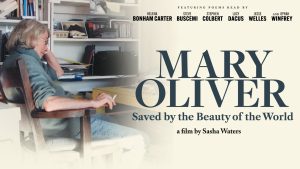
On November 19, IPF and the Carnegie Museum of Art are presenting a free screening of Mary Oliver: Saved by the Beauty of the World, a documentary by Sasha Waters.
Mary Oliver, the Pulitzer Prize-winning poet who taught generations of readers to pay attention to the natural world, actually appeared at IPF in Pittsburgh in November 1979. Nearly half a century later, she returns. On screen. The film features readings by Helena Bonham Carter, Steve Buscemi, Stephen Colbert and Oprah Winfrey, among others. It is also screening on PBS American Masters.
Poetry on the page. Poetry on the screen.
Recently, I watched You Can See Everything, a documentary involving Nathan Fielder, Amanda Seyfried and the curious business of trying to discover the truth through a camera.
It is a film about seeing, performing, observing—and the considerable distance between seeing something and understanding it.
I found myself imagining how the formidable film critic Pauline Kael might have reviewed it. Perhaps something like this:
The film begins by asking whether a performance can reveal the truth, and ends by making us wonder whether the filmmaker himself is performing. Amanda Seyfried, reenacting Holmes, becomes more than an actress playing a role: her criticism of Nathan Fielder turns the camera back on its interrogator. What begins as documentary becomes a documentary about documentary, where every attempt to establish authenticity creates another layer of artifice.
Werner Herzog might have enjoyed the confusion. Cinema vérité, after all, has never guaranteed truth.
You can see everything. You just can’t know what you’re looking at.
Pauline Kael is not available for comment.
And if documentaries make us question what we see, history sometimes makes us question what we thought we knew.
Which brings me to South Asian American History.
Longtime readers may recall my 2023 post La Femme Nikki?, which began with Nikki Haley, wandered through French cinema, and somehow ended with my discovery of the South Asian American Digital Archive (SAADA), its founder Samip Mallick and CMU historian Nico Slate.
That encounter led to the Kedia-Tayur Fund for South Asian American History at CMU, including our annual Distinguished Lecture.
We have now hosted three lectures, featuring Seema Sohi (2024), Neilesh Bose (2025) and Pawan Dhingra (2026).
And we are already planning the 2027 Kedia-Tayur Distinguished Lecture. Stay tuned for the announcement!
Meanwhile, SAADA has something particularly exciting coming up. On December 4, SAADA is hosting a virtual event called Meet the Myth Breakers.
For years, the prevailing historical understanding was that fewer than thirty South Asian women were in the United States during the early twentieth century. New research has uncovered more than 1,300 South Asian women in America before 1947.
Not thirty. Thirteen hundred!
Students, immigrants, community builders, missionaries, revolutionaries—and women whose lives have largely disappeared from the conventional historical narrative. I am delighted to be supporting this SAADA initiative. History, it turns out, is not merely about remembering what we know. Sometimes it is about discovering just how much we didn’t know.
And so, three rather different philanthropic pursuits.
Poetry gives new voices a chance to be heard.
Films give stories a chance to be seen.
History gives forgotten lives a chance to be remembered.
Perhaps they are not so different after all.
Mary Oliver did not want to end up simply having visited this world. Neither do I. There is far too much to see, to savor, and occasionally, to stir up.
After all, life is much too precious to be lived solemnly.


