

On the eve of one of the most important exams of his life, Dr. Sridhar Tayur (1986/BT/ME) DAA made a choice that would seem almost unthinkable to today’s aspirants. He picked up a cricket bat. The JEE, arguably the most competitive gateway in the country, was just hours away. Around him, thousands of students were buried in last-minute revision, clinging to formulas and facts in the hope that one final glance might tip the balance. Dr. Sridhar, however, saw things differently. “Do you think the last four minutes of mugging is going to change anything?” he reflects. “At that point, it is what it is.”
Math, Money and Morals: The Journey of Dr. Sridhar Tayur
In fact, like many students of his generation, his decision to pursue engineering, and IIT Madras in particular, was shaped more by social expectation than personal conviction.
“Your neighbour’s son gets into IIT Madras, your mother says you should too,” he says, recalling the atmosphere with a hint of humour. There was no deep fascination with machines, no childhood spent dismantling engines or building models. “I had no interest in mechanical engineering, or engineering in particular.”
That was 1982. It is a delicious irony that in 2017, I was elected to the National Academy of Engineering! (See Looking Back: October 7, 2017).
Election to the NAE is considered to be among the highest of recognitions in engineering-related fields, and often comes as a recognition of a lifetime’s worth of accomplishments. CMU is ranked number #4 (behind MIT, Stanford and UC Berkeley) in the number of elected members.
As far as I know, no other IIT alum in the 1982-86 batch, across all departments at IIT-Madras, or even across other IITs (I obviously only consider the originals, Bombay, Delhi and Kanpur, okay, fine, let me include Kharagpur, since I am feeling charitable these days!) has yet been elected to the NAE.
The other [elective] was in the Business School. “That was a culture shock,” he says. In engineering, precision and correctness dominated. In business school, ambiguity, discussion, and persuasion took center stage. Case studies replaced equations. Arguments were built not just on logic, but on narrative. “You read a [short] story, and then you argue,” he explains. “And talking persuasively becomes a skill.”
That was 1988. In 2011, Darden wrote a case study about SmartOps, my software enterprise (acquired by SAP in 2013), and in 2013, HBS a case about OrganJet, a social enterprise. You know that I simply cannot resist repurposing Oscar Wilde:
To be the protagonist in one case study, Dr. Tayur, may be regarded as a misfortune; to be in both seems like carelessness.
If you are wondering where the titular phrase came from, it is from my 2017 MSOM article An Essay on Operations Management:
“Leisure, luxury, and the pursuit of newness” has been my mantra for what constitutes a “life of liberty,” and OM has allowed me to operate in the intersection of math, money, and morals.

Math (sports analytics is pretty serious business) and Money met at NFL Draft, this year in Pittsburgh, and so I attended my first one. Not quite the Super Bowl, but still had quite a buzz, and it was fun to reconnect with Jerome Bettis (who was my neighbor, in 1993, his rookie season), bump in Josh Shapiro (both had spent a few hours on our campus earlier as part of several NFL Draft related activities that CMU had planned), but the real treat was to meet Kels (who had performed the National Anthem, excellently I may add, just a little while earlier).
“Money is just fuel for the rocket,” he says, recalling a quote from the filmmaker Brad Bird. “What matters is where you want to go.” This philosophy extends into his philanthropic work, where he supports initiatives in documentary films, South Asian American history, poetry, and beyond, seeking not just to generate wealth but to shape narratives and create lasting social and cultural impact.
Related to NFL (Steelers, specifically), I recall fondly a 2015 fundraiser for the documentary Journey to Normal (by JulieHera DeStefano, in which I was an Executive Producer), co-hosted by Dawn Rucker and Troy and Theodora Polamalu, and supported by several Steelers, at Hotel Monaco.
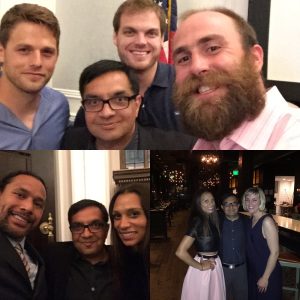
Talking about poetry, looking forward to meeting with Simon Armitage (and of course, attending his readings, yes, two of them, one at CMU and the other, as part of International Poetry Forum, at the neighboring Heinz Chapel) on Tuesday April 28. I wonder how many folks will be there that also attended the NFL Draft: is this an Either/Or situation, are there others, like me, who have a Both/And approach to life.

Today, Dr. Sridhar embodies multiple roles: professor, entrepreneur, investor, and philanthropist.
But he doesn’t see them as separate. “They’re all the same thing,” he says. “Different manifestations of the same idea.”
Of course, the Gold Standard is
genius, billionaire, playboy, philanthropist
from
Marvel’s The Avengers (commonly referred to as simply The Avengers) is a 2012 American superhero film based on the Marvel Comics superhero team of the same name. It has box office receipts of over $1.52 billion (on a budget of $225 million).
Perhaps, with sufficient amount of accumulated Karma Points in this life, who knows how it will play out in my next one! After all, all this is supposedly just
Lila (Sanskrit: लीला, līlā) is a foundational Hindu concept translating to “divine play,” “sport,” or “spontaneity”. It describes the cosmos not as a rigid creation, but as a spontaneous, aimless display of the Divine (Brahman). It signifies that life is a joyful, dramatic, and creative unfolding rather than a necessary, laborious, or goal-driven process.


