

A few weeks ago, CNBC reporter Kevin Williams called with what seemed like straightforward questions.
An Iranian strike on a Saudi petrochemical complex has disrupted production of a resin used in printed circuit boards. Goldman Sachs estimates that PCB prices have risen sharply. Would consumers notice? Would iPhone prices go up? Was Apple insulated by its supply chain sophistication? Were there substitutes available?
The resulting article – posted last Sunday – explored how a disruption thousands of miles away might eventually find its way into the prices consumers pay for electronics.
Inflation inside the electronics you buy may soon become a bit more sticky.
These kind of questions we operations management professors receive all the time.
The more I thought about it, however, the less interested I became in the immediate answer.
The real question was not whether a smartphone might cost a little more next year.
The real question was why so much of the world depended on a single source in the first place.
How did we get here? And, why it is a target for attack.
These questions eventually became a working paper. But while writing it, I found myself thinking about Tolstoy‘s War and Peace.
Not because Tolstoy understood supply chains.
Because he understood history. And because he understood how intelligent people become prisoners of successful ideas.
Operations Management (OM) has been one of the great success stories of modern applied science.
First came efficiency.
We learned how to reduce inventories, improve service levels, design networks, quote lead times, and synchronize increasingly complex operations. My early work at GE Electromaterials in (1994, the year of Pulp Fiction) Coshocton, Ohio, lived in that world. We optimized production schedules and lead times, implemented JIT and Kanbans, at a laminate plant whose descendants now sit in the middle of today’s electronics supply chains.
Then came responsiveness.
We designed rapid-response supply chains (at Caterpillar) that were featured in Fortune magazine.
I put it together as Planned Spontaneity: a designed amount of responsiveness on an efficient backbone.
Later, SmartOps extended those ideas across global networks, helping companies such as Cisco, Jabil, and Celestica manage inventory and uncertainty at scale.
Then came resilience.
Earthquakes, tsunamis, hurricanes, labor disruptions, and eventually COVID taught us that efficiency alone was insufficient. Many researchers, notably my friends and academic colleagues Hau Lee, Steve Graves and David Simchi-Levi, expanded the field’s vocabulary.
Agile. Flexibility. Time-to-recover.
In parallel came sustainability.
Emissions, circularity, stakeholder interests.
Each layer extended the one before it.
None replaced it.
That is what struck me while writing this paper:
The next step is another extension. You know – like the case of why I believe that sustainability cannot really be meaningfully studied without acknowledging and accommodating politics, something I have written about earlier in Capitalism, Supply Chains and Democracy – it will be:
Interweaving Political Economy into Operations Management: POEM.
As the CNBC article highlights:
- Resin is a critical component in the manufacturing of printed circuit boards, which are the nervous system of every modern device, and when board costs spike, the pain moves fast through phones, laptops, wearables, gaming consoles, routers, and AI servers.
- The Jubail petrochemical and industrial complex in Saudi Arabia is offline, knocking out a key world reservoir of resin, and its operational status remains in flux and subject to what could be a lengthy restart process due to the Strait of Hormuz and other war-related issues.
Here is a simple schematic:
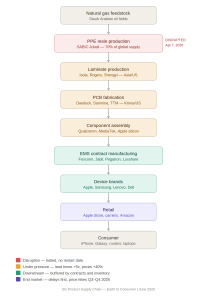
The supply chain in question begins with natural gas in Saudi Arabia and ends with an iPhone in someone’s hand.
In between lie resin plants, laminate manufacturers, PCB fabricators, semiconductor firms, contract manufacturers, logistics providers, retailers, and countless decisions made by thousands of people across dozens of countries.
It is an extraordinary achievement.
It is also a reminder that supply chains are not merely technical systems.
They are political systems.
The old frameworks did not ignore risk. Far from it. They became increasingly sophisticated in dealing with disruptions. But most disruptions they were designed to address shared an important characteristic: they were external to strategic human choice.
Hurricanes do not choose targets. Earthquakes do not pursue political objectives.
The disruptions emerging today are often different.
States are actors. Trade routes become strategic assets. Critical materials become instruments of leverage.
The environment itself becomes part of the model.
The challenge is not that the old frameworks are wrong.
The challenge is that the world has become larger than the frameworks were originally designed to encompass.
Tolstoy understood something similar.
He rejected the idea that history is driven solely by great individuals. Instead, he saw history as the interaction of countless decisions, institutions, incentives, accidents, and forces larger than any one person could comprehend.
Modern supply chains feel much the same.
Tolstoy’s deeper point was that Napoleon didn’t cause the war — the war caused Napoleon to seem inevitable. The iPhone supply chain works the same way. No single executive designed it to be fragile. No single government controls it. No single company understands all of it. Fragility is what emerged — from ten thousand individually rational decisions, made across decades. These executives were of a peacetime mindset. Each was doing their job well. The war came.
The CNBC question that started this journey was ultimately about inflation.
But it led me somewhere else.
It led me back through thirty years of operations management research and practice.
From efficiency to responsiveness to resilience to sustainability.
And now, perhaps, toward a new layer of thinking in which geopolitics, political economy, and operations management become inseparable.
Tarantino understood what profound complacency can do. In Pulp Fiction, Vincent Vega is a professional — experienced, competent, unsentimental. He is also killed because he left his gun in the bathroom. What makes Vincent truly tragic is not the carelessness. It is that he was warned. When bullets miraculously missed them both, Jules saw a sign and changed his life. Vincent called it a coincidence and ordered coffee. He did not update his model. He went back to his routines, his habits, his peacetime assumptions — and the next time danger arrived, he was unarmed, completely unprepared. The supply chain literature had its Jules moment after COVID. Most boardrooms had their Vincent moment.
But frameworks, unlike Vincent, can learn. At sixty, I find that comforting rather than troubling.
The best intellectual frameworks do not last because they are perfect. They last because they evolve.
In War and Peace, history never stops moving.
Neither do global supply chains.
The task is not to abandon yesterday’s ideas. It is to extend them far enough to meet tomorrow’s reality.
I am looking forward to discussing these ideas at Supply Chain Thought Leader Roundtable 2026 at WHU in Munich at the end of this month.
In the mean time, as I post this, here are the Live Updates from the NYTimes:
U.S.-Iran Strikes Risk Taking Conflict Into New Phase.


