
This is Sanskrit for Necklace (mala) of Gems (ratna) on Universe (vishva) as I riff Jyothisha-Ratna-Mala (Garland of Jewels on Astrology) by
Śrīpati (c. 1019 – 1066), also transliterated as Shri-pati, was an Indian astronomer, astrologer and mathematician. His major works include Dhīkotida-karana (1039), a work of twenty verses on solar and lunar eclipses; Dhruva-mānasa (written in 1056), a work of 105 verses on calculating planetary longitudes, eclipses and planetary transits; Siddhānta-śekhara a major work on astronomy in 19 chapters; and Gaṇita-tilaka, an incomplete arithmetical treatise in 125 verses based on a work by Shridhara.
In ancient times, astronomy and astrology were studied as one, and so jyothisha (at that time) could also mean astronomy, unlike today, where it is generally taken to be astrology. Thus, I am using vishva, which generally means Universe, as a stand-in for Cosmology and Astrophysics.
I decided to skim through jyothisharatnamala as I was putting final touches on the gem TLP7: The Chandrasekhar Limit, greatly encouraged having received this email (from Chander Velu) a couple days ago on TLP2: What did Max Planck do?:

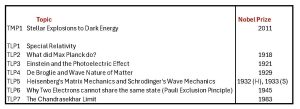
I want to take this opportunity to introduce, in verse, close to the style of Kalidasa, the first seven gems supporting the first necklace (Tayur Musings on Physics, TMP: Stellar Explosions to Dark Energy):
विश्वरत्नमाला
(अनुष्टुभ् छन्दः)
मङ्गलश्लोकः — कण्ठहारः
तारकाग्नि–समुद्भूतं
रहस्यं विश्वविस्तृतम् ।
उदयेऽस्तमये चैव
तद् विश्वरत्नमालिका ॥
सप्तरत्नानि — प्रथमभागः
प्लाङ्कः प्रमाणबीजं तु
काले धृत्य न्यवेशयत् ।
आइन्स्टिनः सापेक्षत्वं
जगतो नियमं व्यधात् ॥
तेजसः कर्मणोश्चैव
गूढं बन्धं न्यदर्शयत् ।
देब्रोग्ली द्रव्यतरङ्गं
मौनमिव न्यवेशयत् ॥
सप्तरत्नानि — द्वितीयभागः
हैसेन्बर्गः प्रमाणानां
सीमां बोधे न्यदर्शयत् ।
श्रोडिङ्गरः तरङ्गेषु
विश्वगीतिं न्यवेदयत् ॥
पौलिना भेदधर्मस्तु
स्वभावे विनियोजितः ।
चन्द्रशेखर–सीमान्ते
नभोऽन्ते तिष्ठति क्रमः ॥
PS. English Translation
Necklace (Invocation)
Born of stellar fire,
a mystery spread across the universe—
present in both arising and fading:
this is the Viśvaratnamālā, the Necklace of the Cosmos.
Seven Gems (Part I)
Planck placed the seed of measure
firmly within time itself.
Einstein established relativity
as the governing order of the world.
He revealed the hidden bond
between light and action,
and de Broglie placed the wave of matter
like a quiet truth within nature.
Seven Gems (Part II)
Heisenberg revealed the limits
of knowing itself,
and Schrödinger made known
the universe as a song of waves.
Pauli set the law of distinction
into nature’s own being;
at Chandrasekhar’s boundary,
order stands at the edge of the heavens.