

Using the opening line from the Title Song of Dhurander:
Ladies and Gentlemen, you are not ready for this.
Carnegie Mellon‘s 2026 Commencement honorees were announced recently: Jensen Huang — co-founder and CEO of NVIDIA, commencement speaker, GPU king — and Sam Hazo — founder of the International Poetry Forum, first State Poet of Pennsylvania, author of more than fifty books. (I am on the board of the International Poetry Forum, and the delight I felt at Sam’s inclusion was not small. 😊) Rounding out the four: Thomas J. Sargent, Nobel Laureate in Economics (who spent some part of his youth at GSIA, now called Tepper), and Jamie deRoy, CMU alumna and 15-time Tony Award-winning Broadway (recall: Hello, Broadway!) producer returning home.
What a lineup.
But here is the image that really lit up my mind: sitting on my desk, a document that I am writing titled
Algorithm-First Hardware: A Primer on CPUs, GPUs, and FPGAs for QUBO Researchers
whose epigraph reads (with apologies to JFK):
Ask not what the algorithm can do for your hardware, but what the hardware can do for your algorithm.
This is what I have always called maximally inverse. And it is the primary subject of this post.
The Central Inversion
Here is how computing normally works. You have hardware — a CPU, a GPU, a fixed architecture — and you write algorithms that fit it. The hardware is sovereign. The algorithm bends.
Jensen Huang built NVIDIA into a $4+ trillion company on exactly this logic: making algorithms bend toward massive parallel arithmetic. Thousands of identical cores, same instruction, different data. Beautiful. Dominant. Deservedly rewarded.
But what my colleagues Biman Chattopadhyay, Nikilesh B.R., and Anil Prabhakar have built at Quanfluence is the opposite.
Instead of writing an algorithm for a fixed machine, they configured the machine for the algorithm.
How?
An FPGA — Field-Programmable Gate Array — loaded with a bitstream physically becomes the circuit the algorithm requires. Not simulating the computation. Being it. Paired with HBM — High Bandwidth Memory, 1024-bit bus, 500+ GB per second — sitting millimetres away on the same substrate, you get a machine that serves the algorithm rather than the other way around.
The problem we are solving is QUBO — Quadratic Unconstrained Binary Optimization — the mathematical language Ising machines speak, and the starting point for our GAMA algorithm. Solving QUBO well requires search, sort, and decision at every step.
GPUs stumble there: warp divergence, threads forced to serialize when they branch differently. Structural, unavoidable for this workload.
The FPGA’s sort tree is wired in parallel because the wires are physically parallel. The result:
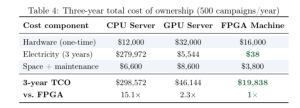
Dear Jensen: it is not just about the GPU. 😊
Meanwhile, On AI and Supply Chains
Also: a podcast from the Tepper School — Can AI Really Transform Real-World Supply Chains?— with my PhD student Tinglong Dai (now at Johns Hopkins) and Emily DeJeu, which draws directly on my post The Importance of Being Skeptical.
The short answer, as regular MyAmpleLife readers will know:
Polite skepticism is the only appropriate response to the claim that AI will soon revolutionize Fortune 500 supply chains. Genuine transformation requires organizational will, cultural change, operational pragmatism, and cross-enterprise agreements — none of which technology alone can supply. Predictive models fail when volatility overwhelms historical data. Agentic aspirations collapse against the stubborn complexities of reality. What is presented as rapid technological revolution is more accurately a slow, laborious, uncertain evolution.
Note the juxtaposition: I am simultaneously arguing that FPGA hardware can genuinely transform QUBO solving right now — and that AI cannot genuinely transform supply chains anytime soon. This is not contradiction. This is precision. The question is always: what exactly is the technology, what exactly is the problem, and does the former actually fit the latter?
Coming Up
Three places to find me speaking about this and related things:
April 7 — Tech Up For Women Podcast (Virtual), 3:00 PM EST. Is Your Business Quantum-Ready, Now? — for everyone, no hardware background needed (although it will help to understand Google Finds Quantum Computers Could Break Bitcoin Sooner Than Expected).
April 16 — CMU Alumni Event (Boston). Innovations in Biology, Tech and Medicine. For the CMU community.
May 12 — Ising Machine Workshop (Singapore). The hardware itself is the subject. FPGA for QUBO. The full story.


