

Sometime in 1999, Wonder Boys was being filmed outside Posner Hall at Carnegie Mellon University.
Directed by Curtis Hanson (who had also directed L.A. Confidential), the film starred Michael Douglas as a fictional English professor at an unnamed Pittsburgh university.
I had just finished teaching and was leaving the building when I saw Douglas walking up the stairs.
I could not resist. I shook his hand and cheekily asked:
“Do you want to meet a real CMU professor?”
Without missing a beat, he replied:
“Can the real CMU professor show me where the restroom is?”
Twenty-seven years later, I was in Seattle for the 21st Tasveer Film Festival & Market, reading Douglas’s newly published autobiography, One Helluva Ride.
I wondered whether his account of Wonder Boys included the professor who knew where the restroom was.
It did not.
But the book made delightful company during a week in which I was myself playing several roles in the film business: philanthropist, juror and Executive Producer.
Not quite Michael Douglas.
But then, he hasn’t founded a supply chain software company either.
Douglas organizes much of his autobiography around his films (and, yes, I have seen all of them). The table of contents reads like a retrospective: One Flew Over the Cuckoo’s Nest, The China Syndrome, Romancing the Stone, Fatal Attraction, Wall Street, Basic Instinct, The American President, Traffic.
I was particularly interested in his career as a producer. Douglas won his first Oscar not for acting, but for producing One Flew Over the Cuckoo’s Nest. Long before he became Gordon Gekko, he understood that getting a film made could be as interesting as appearing in one.
Which brings me back to Seattle.
I have been coming here for nearly thirty years. In 1998, for the INFORMS Conference. In 2002, for discussions between Amazon and SmartOps, the supply chain software company I founded. In 2014, for the MSOM Conference.
Operations Research. Supply Chains. Operations Management.
And now, independent films.
I suppose this is what happens when an Operations Management professor develops an interest in film production and distribution. Eventually, even film festivals begin to look like supply chains. Screenplays are the raw material. Producers and financiers run the factory. Festivals and markets are the trade fairs where buyers meet sellers. Distributors and streamers are the retailers. And, as with any perishable good, a finished film without distribution loses value with every passing season.
As I mentioned recently in Everything Everywhere All at Once, Tasveer has something particularly appealing to me: not merely a film festival, now in its 21st year, but a Film Market, now in its third.
A festival screens films. A market helps films get made, financed and distributed.
RAGS Family Foundation supported Tasveer this year by funding awards. I also served on the Tasveer Market jury alongside Aparna Purohit, CEO of Aamir Khan Films.
That was an enjoyable experience. We were evaluating projects that had not yet become finished films. In other words, making decisions under uncertainty.
At last, something for which my professional training might be useful!
Of course, one cannot simply calculate the expected value of a screenplay and announce the winner. Artistic originality, execution risk, financing and potential audiences all enter the picture.
And the jury has to make a decision anyway.
There was another reason for my presence.
Breaking the Code, Ben Rekhi’s documentary about his father, Kanwal Rekhi, was being screened at Tasveer. I had joined as an Executive Producer, and it was a pleasure to be there with Ben and Kanwal.
Readers may recall Thanks Kanwal for Breaking the (Ind-US) Code!, when I watched the documentary at the New York Indian Film Festival, along with the digitally remastered Sholay.
Kanwal and I have a long-standing connection through entrepreneurship, TiE and the unresolved question of whether IIT Bombay or IIT Madras is the superior institution.
Supporting Breaking the Code is part of our broader RAGS initiative to improve South Asian American representation in media.
Then came a pleasing coincidence.
At Tasveer, I met Sayani Gupta, who appeared in Margarita with a Straw, directed by Shonali Bose.
Now, rewind twenty years.
In 2006, at Pittsburgh’s Silk Screen Festival, we screened Amu on opening day. I had dinner with Shonali Bose, Bedabrata Pain (who later directed Chittagong) and Konkona Sen Sharma.
Twenty years later, I was in Seattle meeting an actress who had worked with Shonali.
The world of independent cinema is smaller than it looks.
Or perhaps I have simply been hanging around it long enough.
For 2026 marks twenty years since I began attending and supporting independent film festivals, starting with Silk Screen and Telluride in 2006. The table tells the story better than a paragraph could:
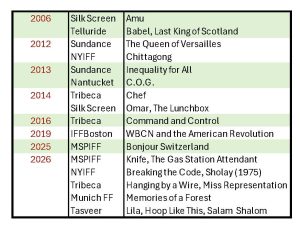
In 2006, at Telluride, I was just an audience member.
In 2026, at Tasveer, I was a supporter, juror and Executive Producer.
There is a curious connection between Douglas’s Hollywood and the independent filmmakers I met in Seattle. His autobiography recounts major productions, celebrated actors, commercial triumphs and occasional disasters. Independent filmmakers face many of the same questions, but usually without large budgets, established distribution channels or recognizable stars.
How does a film get financed? Who takes the risk? How does it reach an audience? And how does a filmmaker get to make the next one?
These are entrepreneurial questions as much as artistic ones.
Perhaps that explains my growing interest. Having spent much of my professional life turning ideas into enterprises, I now find myself thinking about how I can help creative people turn ideas into films.
Gordon Gekko, of course, would have had a simpler selection criterion. Ours was more complicated, and it raised a question I am still thinking about.
My REAP Framework (REAP) approaches South Asian American representation in US media with fairly specific priorities. Tasveer’s mission is broader, and the two do not map onto each other perfectly. Neither is wrong; they are optimizing somewhat different objectives. Finding where they align, and being honest about where they don’t, was a recurring topic over dinners and drinks with Rita Meher and others at Tasveer. I look forward to continuing the conversation.
Michael Douglas called his autobiography One Helluva Ride.
Mine was One Helluva Week.
Twenty-seven years on, I was still finding my way around the film business.
At least I knew where the restroom was.


