

Obviously, I am riffing
Quantum of Solace is a 2008 action spy film and the twenty-second in the James Bond series produced by Eon Productions.
In January, Jay Liebowitz invited me to contribute a chapter to his forthcoming book, Digital Transformation in the Quantum Computing Age. Together with Richard Hampshire, Keith Norman, Chander Velu, and Mudasir Yatoo, I contributed a chapter examining the innovation dynamics surrounding quantum technologies in the energy sector. Our focus was not the physics of qubits but the broader challenge of transforming scientific possibility into economic reality. We wrote about ecosystems, readiness, adoption pathways, and organizational capabilities. In short, we wrote about
The Business of Quantum Technologies: Innovation Dynamics in the Energy Sector.
Hi Sridhar: Thank you for sending your chapter. I just had a chance to read your chapter and you all did a marvelous job. It is well-written, informative, and well-researched. I found POEM, the readiness index, and MLP to be quite interesting.
Thank you again for your valuable contribution to the book.
Best—Jay
I received the above email as I was headed out to Tribeca Film Festival (A Brief History of TIFF) to watch:
Hanging by a Wire is a documentary directed by Mohammed (“Mo”) Ali Naqvi that recounts the dramatic, real-life survival story of six schoolchildren and two adults trapped in a makeshift cable car in a remote region of northwest Pakistan in August 2023. The passengers dangled 900 feet above a valley for over 15 hours.
It played on opening night at Sundance. As the Variety article highlights:
But the dramatic rescue effort, one that involved army helicopters, makeshift chairlifts and ziplines, might not have happened without some social media-savvy community members, who used cellphones and drones to capture the harrowing ordeal and spur the government into action.
“TikTok changed that game,” Naqvi says. “They knew: ‘Don’t call the police. Post these stories on Instagram.’”
After the film, it was good to meet up with Mo, who later also attended a reception, hosted by South Stack Studios, executive producers of the film, at Kidilum, that indeed has a bold take (with exceptionally delicious food) on South Indian cuisine, where it was delightful to meet with several South Asian filmmakers. Thanks to Ben Rekhi for suggesting that I attend the reception, and gracious hosts, Anjana Gopakumar and Reena Mehta, for inviting me. I look forward to continuing our discussions on South Asian American Representation in the media.
Talking about representation, I also enjoyed watching (and meeting one of the protagonists)
Miss Representation: Rise Up is a 2026 documentary directed by Jennifer Siebel Newsom that expands on her acclaimed 2011 film Miss Representation. The sequel focuses on the modern cultural backlash against women’s progress, examining how technology, AI, and deepfakes are used to harass, silence, and marginalize women and girls.
Early next morning, I made my way to Minneapolis for touring one of the most advanced manufacturing facilities in the United States. The tour was conducted personally by Suresh Krishna, CEO of Proto Labs. Before becoming CEO of ProtoLabs, he was twice a SmartOps customer—first at Diageo and later at Polaris. (The past is never dead. It is not even past.)
ProtoLabs sits at the frontier of modern manufacturing. Hundreds of CNC machines are digitally connected. Orders arrive electronically. Production scheduling is automated. Parts can be prototyped the same day and low-volume specialized production runs delivered in days rather than weeks. The facility serves some of the most technologically sophisticated firms in the world, including SpaceX.
As it happened, my visit coincided with the day SpaceX went public.
The symbolism was almost too perfect.
Here I was, standing inside a facility helping support one of the defining technology companies of our era, on the very day that company entered the public markets, after spending the first half of the year writing about quantum technologies.
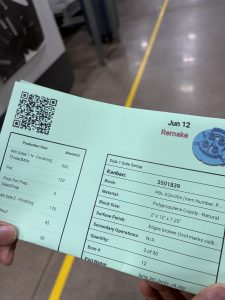
And then I saw it.
A Kanban card.
A simple visual control mechanism attached to material.
Not a quantum computer. Not an AI agent. Not a digital twin. A Kanban card.
For a moment, time folded back on itself. My doctoral dissertation at Cornell in 1990 was titled Analysis of Kanban Controlled Serial Production Lines, work that eventually led to four papers, including this one in Management Science. A few years later, I helped implement Kanban systems at GE. (War and Peace). At McKinsey, as a Consultant to the Firm, I worked with OEMs and suppliers pursuing just-in-time (JIT) transformations (Meditation on McKinsey). Later came SmartOps, with enterprise inventory optimization (EIO) that connected them all. Standing in one of the most advanced manufacturing facilities in America, on the day SpaceX entered the public markets, I found myself staring at a small piece of paper attached to a container of material.
What struck me later was that the documentary and the factory tour were perhaps not as unrelated as they first appeared. In the film, a rescue effort depended on information flowing through a network of villagers, smartphones, drones, social media platforms, journalists, and government agencies. In the factory, a Kanban card conveyed information through a production system. Our quantum chapter, meanwhile, concerned a very different kind of information system: quantum technologies whose promise lies in sensing, processing, and communicating information in ways that classical systems cannot.
I am savoring the possibility that I have spent much of my professional life circling the same question from different directions.


