

June 16. I submit a paper to the INFORMS Journal on Data Science: Quantum Sensing as an Optimization-Inference Stack.
June 17. Tepperspectives publishes my interview: Business in the Second Quantum Revolution.
June 22. The White House signs Executive Order 14411: Ushering in the Next Frontier of Quantum Innovation.
Spooky?
Einstein called entanglement “spooky action at a distance” — his skeptical label for the phenomenon where two particles, separated by any distance, instantaneously share a quantum state. Aspect, Clauser, and Zeilinger won the 2022 Physics Nobel Prize proving he was wrong to be skeptical. The phenomenon is real.
Something analogous happened last week between Pittsburgh and Washington. Two institutions — one academic, one governmental — looking at the same hardware maturity curve, arrived at the same conclusion within six days of each other.
That is not spooky. That is a signal.
The Tepperspectives interview tried to say something simple to a business audience: the computational tools of the past century are approaching their absolute physical limits. Quantum is not just a physics story. It is an optimization story constrained by physics. The corporations — and now apparently the governments — that learn to navigate the subatomic landscape will solve the previously unsolvable.
My IJDS submitted paper made the same argument more formally, for the INFORMS Data Science (DS) community. The two hardest design problems in any quantum sensor — what state should the probe be in, and what measurement should be performed — turn out to be semidefinite programs. Everything downstream is already in our Operations Research (OR) toolkit: Bayesian bandits, reinforcement learning, stochastic integer programming.
Quantum sensing is not a peripheral physics specialty. It is a source of unusually clean optimization and inference problems, with exact forward models, certified precision ceilings, and a direct correspondence between algorithmic reward and physical information gain.
The EO’s quantum sensing section reads like a to-do list drawn from Section 8 of that paper — not because anyone in Washington read a preprint, but because the field has matured to the point where both a business school professor and a presidential administration are staring at the same set of facts.
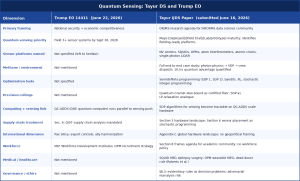
Here is what the EO actually mandates on sensing. The Secretary of War must identify at least three next-generation quantum sensor projects to field by September 30, 2028. The Secretary of Commerce must develop a five-year plan for commercial readiness of quantum sensing. The Secretary of Energy must plan for quantum sensing to measure and characterize complex systems. NSF must plan for basic science research identifying quantum sensing applications. NASA must plan for civilian quantum sensing in space.
This is not a press release about future capabilities. These are deadlines.
My paper’s maturity taxonomy — [Deployed], [Field trial], [Lab/prototype] — is precisely the framework for deciding what “commercial readiness” means for each platform. Optically pumped magnetometers, atom interferometers, and single-photon LiDAR systems sniffing methane leaks at parts-per-million from 200 meters are all at [Field trial] today. The 2028 fielding target is aggressive. It is also not obviously wrong.
The EO was in interagency drafting for months before either the paper or the interview existed. Presidential orders coordinating the Departments of War, Commerce, Energy, State, NSF, NASA, DNI, OPM, and the FBI do not emerge from a single preprint. The National Quantum Initiative Act — also a Trump initiative, 2018 — and the Biden-era quantum orders laid the statutory groundwork. EO 14411 is an update to a long-running federal quantum strategy.
Atomic clocks already underpin GPS. SQUID magnetometers already guide epilepsy surgery. Single-photon LiDAR has EPA qualification for methane monitoring. The White House has now issued fielding deadlines.
The coherence window — June 16 to June 22 — has closed. The signal survived.
Quantum Timing!
(Another installment of La Comédie quantum — honoring Balzac, who was honoring Dante, who were not thinking about executive orders. For the record: Quantum Karma, Quantum ABBA, Quantum GAGA, Quantum Chapati, Quantum Idli.)


