
As you know from my previous posts, I was in Munich for Supply Chain Thought Leader Roundtable (recall its origins from Casablanca, Corsendonk, Como) to moderate a panel on POEM: Interweaving Political Economy (PE) and Operations Management (OM), recall Capitalism, Supply Chains and Democracy – and it was wonderful to meet up with many colleagues, including three of my PhD students, Tinglong Dai, Pinar Keskinocak and Jay Swaminathan, and make new acquaintances – and (obviously) popped in to the Munich Film Festival that was taking place (saw Memories of a Forest).

Apples appear in physics with suspicious frequency. Newton’s apple. Apple Watches correcting their clocks by GPS. Apple Maps depending on relativity. I found myself wondering whether the most famous apple in science has been explained in the simplest possible way.
Munich is not where Einstein created general relativity. It is where a curious boy first learned geometry, puzzled over a magnetic compass, and began asking questions that would occupy him for the rest of his life. Flying home from Munich, I found myself re-asking a much smaller question —but one that lies at the heart of his theory nonetheless:
Why does an apple fall?
(No: It is not because space is curved like the familiar visualization of a heavy bowling ball on a stretchable rubber sheet. If anything, this is actually the absolutely wrong analogy to use here.)
General relativity is almost universally regarded as one of humanity’s greatest intellectual achievements.
Why, then, does its teaching so often begin where its ideas end?
Students are introduced to metrics before they know why a metric became necessary. They learn tensors before they have had the opportunity to be surprised by the physical phenomenon those tensors describe. The mathematics is beautiful but cumbersome—and indispensable—but perhaps it arrives a little too early.
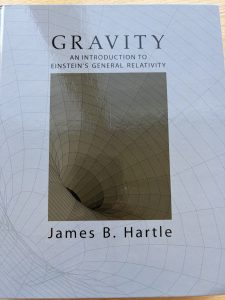
Hartle‘s wonderful “Physics First” philosophy reminded me that there is another way to tell the story. Reading him, I found myself asking whether one could travel even lighter. Could one explain why an apple falls using little more than clocks, special relativity, and ordinary calculus? Could the mathematics emerge because the physics demanded it, rather than because tradition prescribed it?
Here is my new addition to Tayur Musings on Physics:
The issue is not that spacetime is curved. The question is: for an apple, which part of spacetime is doing almost all of the work?
Time.
And, can this be shown without the heavy machinery that is usually introduced first.
As I write in the introduction:
Ask anyone who has watched a science documentary how gravity works, and you will get the same answer: mass bends space, and things roll along the resulting slope, the way a marble spirals into a dip in a stretched rubber sheet. The image is unforgettable – and it is not without merit; it is a memorable visualization of spatial curvature, and a fine one for some genuinely relativistic phenomena. But it is a surprisingly poor guide to the specific question of why an apple falls, and worse, it is mildly circular as a demonstration: the rubber sheet only pulls the marble inward because gravity is pulling the marble down onto the sheet in the first place. The demonstration explains gravity by presupposing gravity.
There is a second, quieter problem with the picture, one that has nothing to do with circularity: it draws attention to the wrong kind of curvature. For an apple falling from a tree, or a satellite in low orbit, or you standing on a bathroom scale, essentially all of the effect comes not from the curvature of space but from the curvature of time. In the solar system, spatial curvature is small enough to be safely ignored for this purpose; temporal curvature is not.
This musing is a demonstration of that fact, built from the ground up, using nothing beyond special relativity and ordinary calculus. By the end, Newton’s inverse-square law – the law Newton himself simply posited, unexplained, in 1687 – will have been derived from a single physical idea: a clock lower in a gravitational well runs slow, and a free body drifts toward wherever its own wristwatch would tick the most.
Indeed, while I am at it, I also want to clearly show why the bending of light around the sun (or a heavy mass) is twice what Einstein himself had first estimated. Here space does play an equal part.
And: why time almost stops at the edge of a black hole.
Finally, I found myself wanting to demystify the metric tensor itself. Rather than presenting it as an abstract geometric object, I prefer to think of it as sophisticated bookkeeping for coordinate systems whose axes are no longer perpendicular and whose rulers no longer have constant length. Once seen that way, much of the notation loses its mystery. Hope you find the appendix as clarifying as much as I enjoyed writing it.
What next this week? Hope you can join us on LinkedIn Live: